
Walk through any major mall in Singapore today, and you will notice a clear shift. Displays that are static are gradually fading into the background, replaced by screens that react, guide, and adapt in real time. The interactive kiosk has evolved from an experimental tool to an operational one.
Singapore’s digital maturity plays a major role here. Over 90% of our customers have access to the internet, and Smart Nation Initiatives have already made them comfortable interacting with technology every day. What has changed is expectations. Speed, clarity, and convenience are no longer differentiators; they are baseline requirements.
As a result, the conversation around interactive kiosks in Singapore has moved beyond adoption. Now, the question is how to implement them effectively to drive measurable business results?
Why Interactive Kiosks Matter More in 2026
Singapore businesses are facing practical tension. In addition to rising labour costs, customers are also becoming more demanding about service quality and speed.
Interactive kiosks sit directly at this intersection.
Self-service kiosks have been proven to reduce queue times by as much as 25% to 30% in retail and F&B environments across Asia. More importantly, they create consistency. Kiosks present options without rushing, forgetting, or varying. In addition to increasing average order value, it can also increase upsells and prompts through a well-designed system.
There is a simple reason why many deployments underperform: they are implemented without a clear purpose.
Interactive kiosk design becomes critical here. Kiosks that “exist” and kiosks that perform are differentiated by how well they align with user behaviour and business objectives.
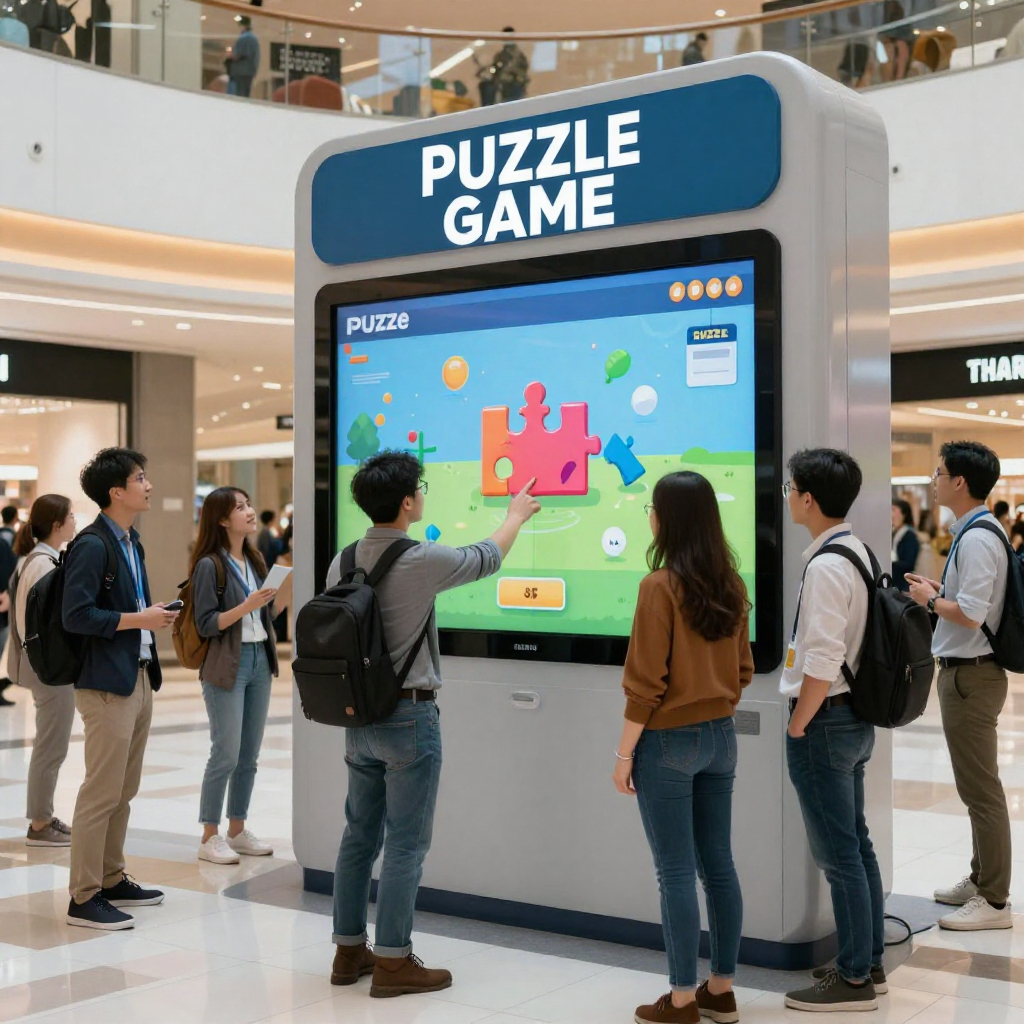
Interactive kiosk ideas backed by Real Use Cases in Singapore
The term “interactive kiosks” is often used too broadly. It is important to note that different formats serve very different purposes in practice. It is only by understanding this distinction that costly misalignments can be avoided.
1. Floor Standing Touch Screen Kiosk
This is the most widely deployed format across Singapore, especially in:
- Quick service restaurants (QSRs).
- Food courts
- High-footfall retail environments
A number of high-profile chains and several local F&B brands, have adopted this model to improve ordering efficiency.
Businesses consistently observe that customers tend to explore more when ordering via screen. In this way, customers often buy more because they see more options, not because of aggressive sales tactics.
Best for:
- Reduce queues
- Increasing the order value
- Standardised service flow
 LCD Horizontal Digital Touch Kiosk
2. Interactive flat panel display
Not every business is looking for speed. Often, in retail showrooms, corporate environments, and education settings, deeper engagement is the goal.
Interactive panels are used in:
- Property showrooms (for virtual walkthroughs).
- Corporate presentations
- Training environments
Using this format allows users to explore at their own pace, which leads to more informed decisions.
Best for:
- Product discovery
- Guided storytelling
- Customer education
3. Interactive digital signage
Traditional digital signage is passive. Interactive signage changes that dynamic.
These formats are increasingly used by brands in Singapore malls and at events for the following purposes:
- Campaign engagement
- Lead capture
- Gamified experiences
Retail campaigns with touch-based interactions or QR integration, for example, tend to have significantly longer dwell times than static displays.
Best for:
- Marketing campaigns
- Brand engagement
- Data capture
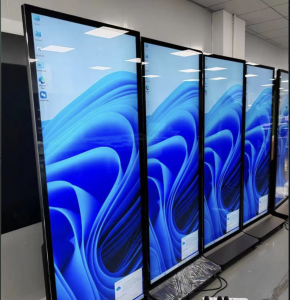 Floor Standing Interactive Display
4. Touch Table
Touch tables are less common but highly effective in the right context.
You will often find them in:
- Luxury retail
- Museums and exhibitions
- Real estate experience centres
By encouraging shared interaction, engagement time naturally increases. The conversion rate can be directly affected by this factor in competitive environments.
Best for:
- High-value customer journeys
- Group interaction
- Premium brand positioning
5. Wall-mounted Interactive Display
Space constraints are real in Singapore. In addition to being practical, wall-mounted solutions provide a functional alternative as well.
Common use cases include:
- Clinic check-ins
- Office directory
- Queue management systems
As a result, they deliver efficiency while leaving a minimal environmental footprint.
Best for:
- Small spaces
- Quick interaction
- Operational efficiency
 Outdoor Wall Mount Screen
6. Custom Interactive Kiosk Design
When standard formats are insufficient, businesses turn to custom builds.
This is particularly common in:
- Large-scale exhibitions
- Luxury retail environments
- Real estate developments
A custom kiosk allows brands to align with their brand identity, physical space, and user journey. The ROI of these approaches is often stronger if they are executed correctly, despite being more resource-intensive.
Best for:
- Unique business requirements
- Brand differentiation
- Integrated digital experiences
Where Interactive Kiosks Deliver the Most Value
Kiosk’ effectiveness depends on how well they are applied to specific industries.
- Retail: Enhances product discovery and reduces floor staff dependency
- F&B: Streamlines ordering and improves throughput during peak hours
- Healthcare: Simplifies patient check-ins and reduces administrative bottlenecks
- Events & Exhibitions: Handles registrations, wayfinding, and engagement seamlessly
Regardless of the sector, there is one pattern that becomes obvious: kiosks perform best when they remove friction rather than add to it.
The Role of Design in Adoption
Technology alone does not guarantee success. Oftentimes, kiosk deployments fail because of poorly designed kiosks, and this is one of the main reasons.
Effective interactive kiosk design in Singapore prioritises:
- Clear and intuitive navigation
- Fast response times
- Strategic physical placement
- Context-relevant content
In Singapore, users are highly proficient with digital technology but are highly time-sensitive. An interface that feels slow or confusing will automatically lead to abandonment rates increasing as soon as it is introduced.
How to Choose the Right Interactive Kiosk in Singapore?
Technology should not be the starting point; instead, it should be the problem you are trying to solve that should be the starting point.
- When lines are congested, self-service kiosks are the best option
- In low engagement situations, interactive displays and touch tables are more effective
- Wall-mounted solutions are more practical if space is limited
The companies that are able to measure results are the ones that align the kiosk format with specific operational goals rather than merely choosing it because it is visually appealing.
Cost and ROI considerations
The cost of the service is one of the most frequently asked questions.
In Singapore,
- Basic kiosk setups typically start from SGD 3,000–8,000
- Mid-range interactive solutions range from SGD 8,000–20,000
- Custom deployments can exceed SGD 30,000 depending on complexity
A cost-benefit analysis should be carried out, but the ROI should be taken into consideration. The following are some of the ways businesses recover their investments:
- Reduced manpower dependency
- Increased transaction speed
- Higher average order value
- Improve your customer experience
ROI can be achieved in high-traffic environments in as little as 6-12 months, depending on traffic volume.
The Outlook for 2026 and Beyond
There is a growing trend in interactive kiosks that go beyond static interfaces.
Key trends include:
- AI-driven personalisation based on user behaviour
- Integration with mobile journeys (start at kiosk, complete on phone)
- Data-driven optimisation of user flows
However, regardless of these advancements, the core principle remains the same: The most effective kiosks reduce friction wherever possible.
Final Thought
There is no longer a “nice-to-have” when it comes to interactive kiosks in Singapore’s business landscape. It has become a baseline expectation to have them.
There is a difference between a kiosk that performs and one that underdelivers based on clarity of purpose, design, and implementation.
A thoughtful deployment of these tools can accomplish far more than automating tasks. As a result, your customers will interact with your company in a completely different way. If you’re planning your next step, consider reviewing interactive kiosk designs or speaking with a specialist at New Wave Display, this will enable you to map the right approach.
Frequently Asked Questions
What is an interactive kiosk, and how does it work?
An interactive kiosk is a self-service system with a touch-enabled interface that allows users to browse, interact, and complete actions like ordering, checking in, or requesting information.
Why are interactive kiosks widely used in Singapore?
Using these systems increases efficiency, reduces reliance on manpower, and meets the expectations of an increasingly digitalised and fast-paced population.
How much does an interactive kiosk cost in Singapore?
Costs vary widely. The most basic units start at a few thousand dollars, while advanced or custom solutions can exceed SGD 30,000.
Which industries benefit most from interactive kiosks?
Customer interaction volumes are highest in retail, food and beverage, healthcare, hospitality, and events.
How do I choose the right interactive kiosk design?
Select a format that supports the primary objectives you want: speed, engagement, or space optimisation.